
A three-year-old who throws themselves on the floor at the supermarket because they can’t have a packet of cookies isn’t throwing a tantrum on purpose. Their brain hasn’t yet developed the neural pathways needed to rein in the intensity of what they’re feeling. Understanding this changes how we respond—and, more importantly, what we do every day to support them.
The adult’s role in helping children regulate their emotions
When a young child erupts in anger or bursts into tears, the adult with them is their first source of support for regulating those emotions. Before suggesting a breathing exercise or an emotions wheel, we send a message through our own response: our tone of voice, posture and breathing pace.
Research on families identifies three ways children learn about emotions: observing adults’ reactions, how adults respond to children’s emotions, and the overall emotional climate at home. A parent who names their own frustration out loud (“I’m annoyed because the line is long. I’m going to take a deep breath”) offers a practical example, not a theoretical lesson.
In practice, when we feel tension rising, we can help young children regulate their emotions by first slowing ourselves down. Get down to the child’s level, lower your voice and wait a few seconds before speaking. This pause, however brief, de-escalates emotions faster than a verbal instruction.

Naming emotions: age-appropriate emotional vocabulary
A two-year-old can’t tell frustration apart from sadness. To them, it all feels the same: something hurts inside. The first step is to give them simple words that match what they’re experiencing in the moment.
Under three: four words are enough
Happy, sad, angry, scared. Consistently link each word to a specific situation: “You’re angry because your brother took your truck.” Naming an emotion as it happens helps the word stick far better than looking through a picture book when nothing is going on.
Visual aids such as cards with faces or puppets can still be useful, but as a supplement. What matters is consistency: every everyday situation—mealtimes, playtime, bedtime—is an opportunity to put a word to a feeling.
Ages three to five: adding nuance to their vocabulary
You can introduce more specific words: disappointed, jealous, proud, worried. Children begin to connect what they’re feeling with what triggered it. At this age, move from describing the emotion for them to asking an open-ended question: “How are you feeling right now?”
This shift from passive labeling to self-identification is a milestone in the development of emotional awareness. It doesn’t happen overnight, and some children may need several more months than others, depending on their temperament and exposure to language.
Practical strategies for everyday emotional regulation
These techniques work best when they’re brief, repeated and suited to the situation. A breathing exercise learned in a workshop but never practiced at home is quickly forgotten.
- Balloon breathing: the child imagines inflating a balloon in their belly as they breathe in, then slowly letting the air out. Three cycles are enough to ease agitation. Practice at bedtime to make it a habit before using it during a crisis.
- A calm-down corner: a designated space with a cushion, blanket or stuffed animal where the child can go when things feel overwhelming. It’s not a punishment; it’s a safe place. Set it up together so the child feels it’s their own.
- A glitter jar: a jar filled with water and glitter that you shake. The child watches the glitter slowly settle. This quiet observation redirects their attention and slows their internal pace without requiring them to talk.
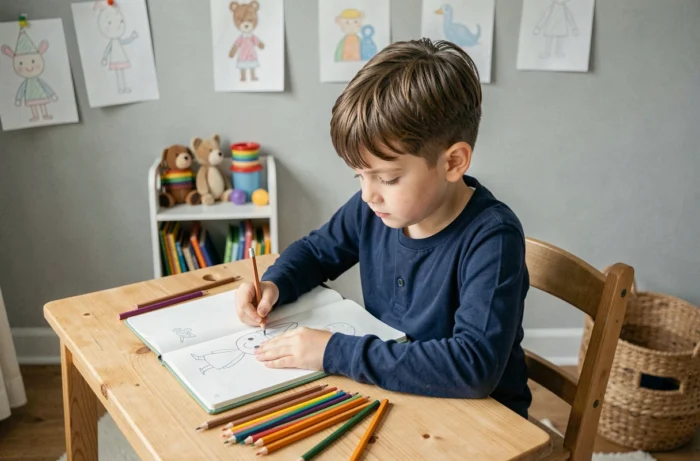
- Drawing an emotion: offer a pencil and paper and invite the child to draw “what you’re feeling.” Even an angry scribble helps release tension. Don’t interpret the drawing; simply acknowledge it: “I can see this feels really big.”
How well these strategies work varies from child to child and from one moment to the next. A tool that works at four may lose its appeal at five, so it’s important to refresh the toolkit.
Consistency between home, school and extracurricular settings
We often underestimate how changes in environment affect emotional regulation. A child who has learned to breathe into an imaginary balloon at home but never hears the same language at school can lose their bearings.
Santé publique France describes the development of psychosocial skills as an approach that involves several areas of a child’s life, as part of an interministerial strategy covering 2022–2037. In practice, this means that parents, teachers and activity leaders benefit from using the same words for the same emotions.
A simple step: share the two or three strategies your child uses at home with their teacher or childminder. If the school has a similar calm-down corner, the child can carry what they’ve learned from one setting to another.
The screen trap: using devices as a substitute regulator
Giving a child a tablet to calm a meltdown works in the moment. The silence returns and the tension eases. A report by Terra Nova points out that this can replace interactions—playing together, reading and talking—that help develop attention and emotional regulation.
This isn’t about banning screens, but about not using them as an emotional fire extinguisher every time. The challenge is real: everyday demands sometimes leave little room to maneuver. Saving screen time for moments of intentional relaxation rather than meltdowns helps preserve a child’s ability to develop their own ways of calming down.
Supporting a child as they learn to manage their emotions isn’t just about following a list of techniques. It’s an ongoing adjustment between what the adult models, what the child is ready to take on, and the consistency between the different places they spend time. Progress is rarely linear, but every word put to a feeling helps build a foundation that will serve them well beyond early childhood.