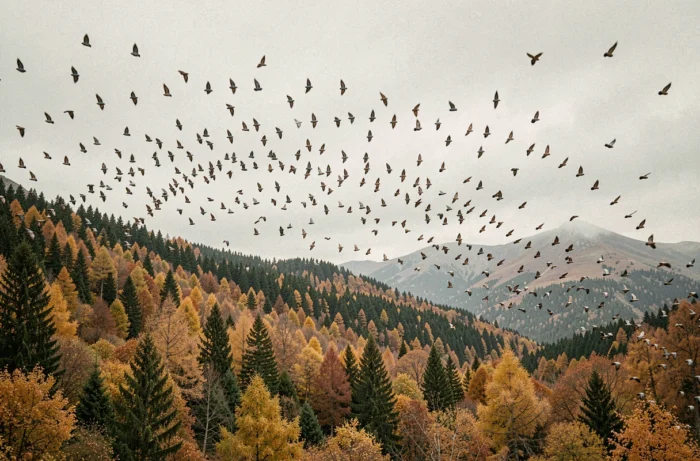
Every autumn, millions of wood pigeons leave northern Europe for the Iberian Peninsula. Today, this migration is tracked through daily counts at fixed points, combined with real-time reports from citizen observers. Understanding this data helps you know when a major passage is underway and where to go to watch it.
Scientific counts at the Pyrenean passes: the reliable foundation for migration tracking
Before checking an interactive map or an online group, one source of data deserves your attention: four Pyrenean passes are monitored scientifically every day throughout the migration season. These surveys, coordinated in particular by GIFS (Groupe d’Investigation sur la Faune Sauvage), do more than count the birds passing on any given day.
They contribute to annual data series that make it possible to compare seasons. A high daily total means little when viewed in isolation. Counting conditions (visibility, wind, flight altitude) vary from day to day, and the same number of birds can reflect very different circumstances.
For example, on October 26, 2026, a major passage was recorded at the passes in clear weather and light winds. In some areas, the birds were flying very high, making them difficult to spot from the ground. A high bird count does not guarantee easy viewing from every vantage point.
If you’re planning a birdwatching trip, it’s best to compare live wood pigeon migration tracking with this scientific data rather than relying on a single report on social media.

Major migration or local movement: how to tell the difference
Have you ever seen a flock of wood pigeons fly over your garden in October and thought migration was in full swing? That flock could be part of one of three distinct situations.
First, a genuine migratory flow, with birds travelling from Scandinavia or northern Europe. Second, a local movement between feeding areas, unrelated to migration. Third, and less widely known, migration resuming after a period of settling in one area. Some wood pigeons may stay in one territory for several weeks before continuing south when the weather changes.
GIFS combines visual counts, ringing and GPS tracking to distinguish between these cases. Comparing counts from several passes on the same day provides an initial clue. If large numbers pass through several locations at once, it is probably a genuine migratory flow. If only one site records a peak, it’s best to be cautious.
How to identify a genuine migratory passage
- Flights head consistently south or southwest, with birds flying in lines or V formations at high altitude
- Several counting sites (Pyrenean passes, as well as locations in Belgium, Germany or Switzerland) record a significant increase at the same time
- Weather conditions match the typical pattern: a cold front followed by clear skies, with a favourable tailwind
- The birds do not stop to feed nearby but continue on their way without a prolonged pause
This last point is a useful field guide. Wood pigeons stopping in a freshly harvested cornfield are not necessarily actively migrating.
Where to watch wood pigeon migration in France
The Pyrenean passes remain the best-known observation points. Col de Lizarrieta, in the Pyrénées-Atlantiques, has a formal monitoring programme whose data is available on the Migraction platform. But significant passages also occur far from the Pyrenees.
In autumn 2026, counts showed contrasting trends in Belgium, northern Germany, Switzerland and Italy. Checking just one monitoring site focused on the southwest gives only a partial picture of the season.
Compare several sources to choose your observation point
- Migraction.net brings together data from dozens of French sites, with charts by species and day
- Falsterbo Fågelstation in Sweden publishes daily counts of birds departing on their Scandinavian migration
- Citizen birdwatching groups (palombe.com and specialist social media groups) report passages in real time, but without a standardised protocol
Falsterbo station is particularly worth watching. When it records a peak in departures, it can take several days for those birds to reach northern France, depending on wind and weather conditions.

Migration calendar: key periods and common pitfalls
The migration season runs from mid-September to late November, with varying intensity. The period around Saint Luke’s Day, around October 18, traditionally draws the attention of birdwatchers and hunters. But this date is no on-off switch.
In some years, most of the passage has already taken place by then. In others, it comes later, delayed by a mild autumn. Annual data series show that no two seasons are exactly alike.
A common pitfall is comparing one season’s total with the previous year’s without taking counting conditions into account. If visibility was better or more observers were present, the total will rise automatically, even if the actual number of birds has not changed.
Likewise, a major passage recorded at the passes does not necessarily mean a sustained increase in the wood pigeon population. Annual migratory flows and changes in the species’ population are two distinct measures that GIFS works to separate through ringing and GPS tracking.
For the best chance of seeing wood pigeon migration, keep an eye on daily counts from several sites, look out for a favourable weather window (clear skies after a cold front, with northeasterly winds), and head to an open, elevated vantage point early in the morning. A true major passage, with continuous flocks for several hours, rewards patience and careful attention to the data.