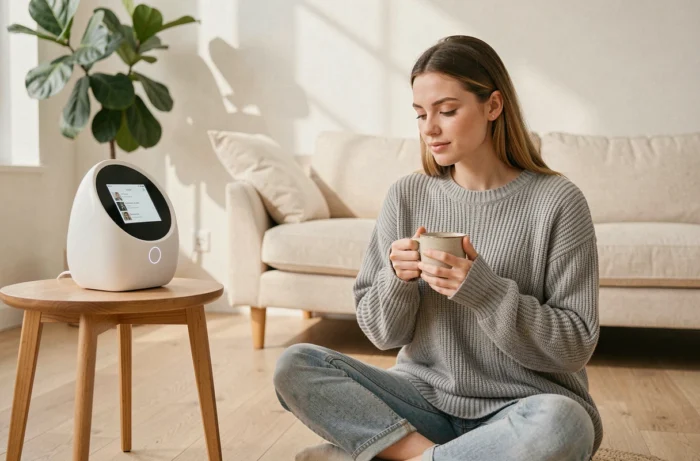
A baby monitor is a device that transmits audio, video, or both between a child’s room and a receiver held by a parent. Choosing a model involves specific technical criteria, some of which—such as the length of software support or the actual reliability of its range—are rarely detailed on product pages.
Real-world baby monitor range: why the specifications aren’t enough
The range stated on the packaging is measured in an open field, with no obstacles. In practice, load-bearing walls, concrete floors between levels, and closed doors reduce reception distance, sometimes by half or more.
Testing the device in the conditions in which it will actually be used (with the bedroom door closed and the receiver on another floor) is the only reliable way to check coverage. One thing to check first: the connection-loss alert must work. If the signal drops without a notification, the parent may think they are monitoring their child when the transmission has actually stopped.
For a closer look at the differences between audio, video, and connected models, detailed comparisons and real-world tests are available at https://www.babyphoneinfos.com.
Audio, video, or connected baby monitor: practical criteria for choosing
There are three main categories, and the right choice depends less on budget than on how the monitor will actually be used day to day.
An audio baby monitor picks up sounds in the room and transmits them to a dedicated receiver. Its simplicity is an advantage: no network setup, no user account, and no risk of hacking over the internet. The trade-off is that there’s no video: a child who quietly climbs out of their crib won’t trigger an alert.
A video baby monitor with a dedicated screen adds a camera and a small monitor. The connection stays local (analog or digital radio), so it doesn’t rely on your home Wi-Fi. Night vision, available on most video models, lets you see into the room without turning on the light.
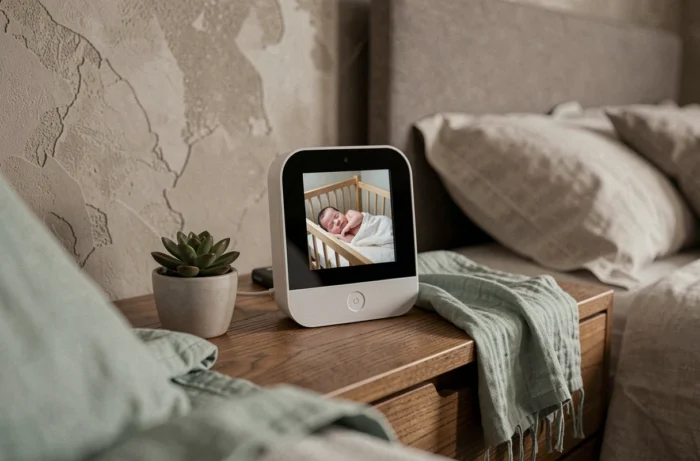
A connected baby monitor (Wi-Fi) streams video to a smartphone through an app. It lets you monitor your child remotely, even when you’re away from home. The trade-off is that it depends on your internet connection, the manufacturer’s server, and regular software updates.
- Audio only: suitable for small homes where the bedroom is nearby, when simplicity matters more than video.
- Video with a dedicated screen: suitable for multi-storey homes or parents who want to see their child without relying on Wi-Fi.
- Wi-Fi connected: suitable for remote monitoring, but requires checking the update policy and account security.
Connected baby monitors and cybersecurity: software support duration matters
A Wi-Fi baby monitor is a connected device, just like a security camera or router. Its security depends directly on the updates the manufacturer releases after purchase.
The European Cyber Resilience Act will require manufacturers, from 11 September 2026, to report actively exploited vulnerabilities and serious incidents to the authorities within the deadlines set out in the regulation. The general requirements for addressing vulnerabilities throughout a stated support period will apply from 11 December 2027.
In practical terms, checking the stated support period before buying is becoming an important selection criterion. A model whose manufacturer makes no commitment to a period of software updates could become vulnerable within a few months, with no recourse available.
When the manufacturer stops responding
The most problematic scenario is a connected baby monitor used every night after its manufacturer has stopped releasing updates—or, worse, shut down its servers. The app no longer works, the camera can’t be accessed remotely, and security vulnerabilities remain unpatched.
A few simple steps can reduce the risks:
- Before buying, check that the manufacturer provides an accessible update history and commits to a support period.
- Change the default password for the baby monitor and app as soon as you first use them, then enable two-factor authentication if available.
- If support is discontinued, switch to a video model with a dedicated screen (without Wi-Fi) that doesn’t rely on an external server.
The CE marking on the packaging indicates that the manufacturer has declared the product compliant, but it is not an independent cybersecurity certification. Checking the account security options and update policy provides more reliable information than the CE logo alone.
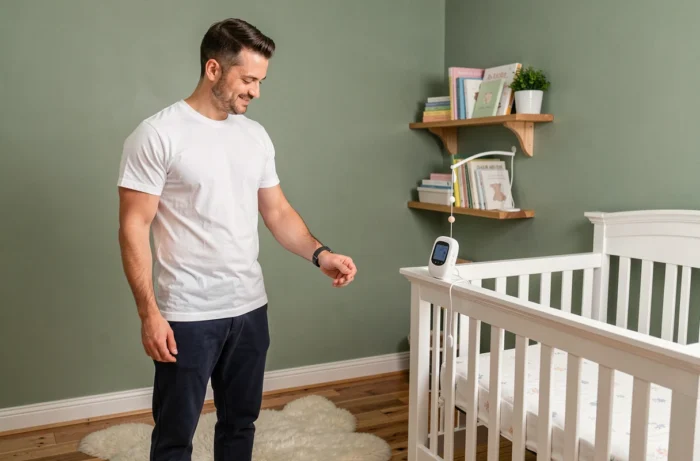
Motion sensors and sleep monitoring: what a baby monitor can’t replace
Some models include a motion sensor placed under the mattress or breathing monitoring through the camera. These features can be reassuring, but they should not be mistaken for a medical device.
A baby monitor detects a sound or shows an image; it does not guarantee a child’s safety. An under-mattress sensor cannot, on its own, provide a diagnosis. Recommended safe-sleep practices (placing the baby on their back, without a blanket or other items in the crib) remain the first line of prevention, regardless of the device used.
A baby monitor supports parental vigilance; it doesn’t replace it. The most suitable device is one whose technology matches the layout of your home, whose manufacturer provides documented software support, and whose limitations are understood from the very first night of use.