
The natural wellness market encompasses hundreds of practices, products and information platforms. From naturopathy advice and herbal dietary supplements to mind-body disciplines such as yoga and qigong, the range of options has expanded considerably in recent years. Online resources have multiplied at the same pace, making it harder for people to find reliable approaches suited to their needs.
Check the reliability of a natural wellness practice before committing
The first challenge, even before choosing a resource, is to assess what constitutes a serious approach and what amounts to misleading or commercial messaging. One official tool is worth knowing about: the derivometer published on sante.fr, designed to help the public spot warning signs associated with non-conventional health practices.
This tool helps identify risky situations, such as a practitioner asking someone to stop medical treatment or promising a guaranteed cure. It is more useful than a simple editorial ranking because it focuses on problematic behavior rather than on the practices themselves.
The DGCCRF also points out that, with exceptions such as osteopathy, chiropractic and acupuncture, practicing non-conventional healthcare is not conditional on holding a qualification recognized by the State. Even extensive private training is not equivalent to a healthcare professional qualification. Checking a practitioner’s stated credentials is therefore an essential step before any consultation.
Finding your way through resources dedicated to natural wellness requires a structured overview. For example, the Pur Bien-Être sitemap provides a thematic map of the available content, making it easier to find relevant topics without running multiple searches.

Natural dietary supplements: what the label doesn’t always tell you
Herbal dietary supplements feature increasingly often in searches related to natural wellness. Describing them as “natural” can inspire confidence, but that doesn’t mean they shouldn’t be examined carefully.
The DGCCRF regularly checks health claims on packaging and online product listings. A product described as natural is not automatically safe or effective. Some plants interact with medicines, while others are not recommended during pregnancy or for people with chronic conditions.
A few checks can help you make an informed choice before buying:
- Look up the plant in the Vidal database to check for known contraindications
- Check that the manufacturer lists the full ingredients, including excipients, rather than just naming the featured plant
- Make sure health claims are measured (a dietary supplement is not a medicine and cannot legally claim to cure a disease)
The same caution applies to online content recommending products. An article sponsored by a supplement brand is not as neutral as an information sheet from an official institution.
Health misinformation: tools for checking natural health claims
The proliferation of social media content has made health misinformation more visible. Viral claims on TikTok or Instagram sometimes circulate without any scientific basis, then get repeated by blogs that lend them an appearance of legitimacy.
Several institutional initiatives aim to identify and report misleading content on major digital platforms.
For anyone researching natural wellness, the question to ask when reading a piece of content is simple: can you identify the source, and can you verify the claim somewhere other than the site publishing it? Health advice that cites no sources, or relies on a single anecdote presented as proof, should be cross-checked.
Distinguishing information from promotion
The line between informative and promotional content can sometimes be blurred in the natural wellness field. A naturopathy blog may publish high-quality articles while also selling courses or products. This dual role doesn’t invalidate the content, but it does make it worth checking other sources.
Institutional websites (sante.fr, HAS) remain the most reliable sources for verifying health information. They have no products to sell and no practices to promote.
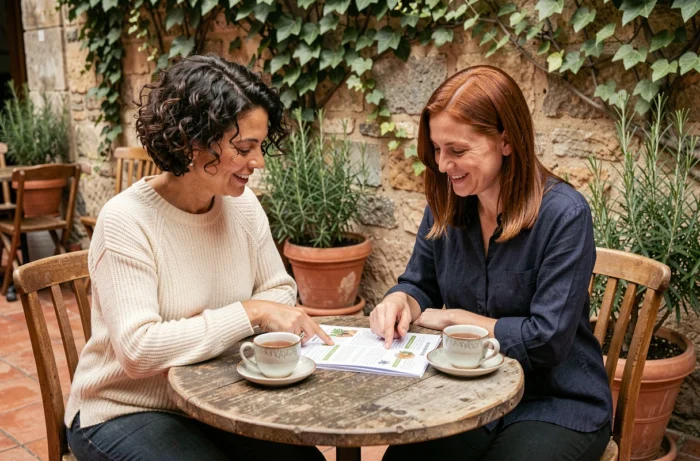
How to structure your search for natural wellness resources
Searching for “natural wellness” returns millions of results. Without a method, this mass of information becomes an obstacle rather than a help. A more effective approach is to start with a specific need rather than a generic term.
Someone who has trouble sleeping doesn’t need a comprehensive guide to the seven pillars of wellness. They need targeted information about sleep, related plants (valerian, passionflower), evidence-based relaxation techniques, and the limitations of each approach.
- Identify the specific need: sleep, stress management, diet, joint pain or skincare
- Start with institutional websites or medical databases to establish a factual framework
- Supplement these with specialist websites that are transparent about their editorial approach (legal notices, author details and cited sources)
- Avoid content promising quick or universal results, because no wellness practice has the same effects on everyone
This step-by-step approach cuts through the information overload and helps you find useful content faster. It also prevents you from getting caught in reading spirals where each article links to another without ever answering your original question.
Natural wellness covers a broad spectrum, from nutrition and stress management to mind-body practices and herbal remedies. The available resources reflect this diversity, with widely varying levels of reliability. Cross-checking sources, verifying practitioners’ credentials and prioritizing official fact-checking tools are the most direct ways to find your bearings without getting lost.