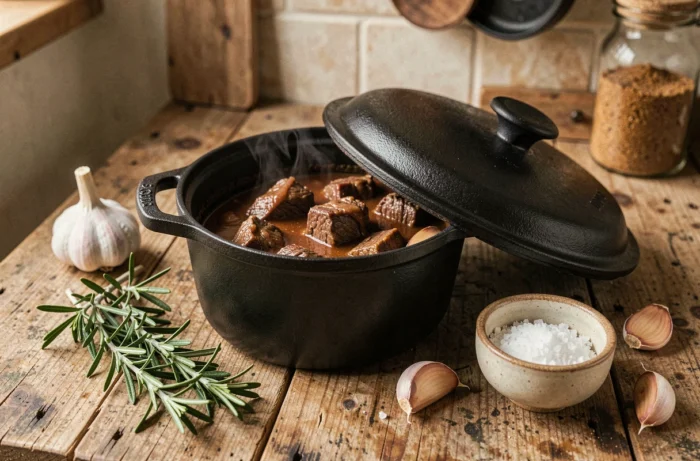
The cast-iron Dutch oven market is split between a handful of established manufacturers and a newer range of products, often made from cast aluminum, that can make it hard to tell them apart. Prices can vary fivefold for cookware that looks similar. Understanding what accounts for these differences means looking at the material itself, how the products are made, and what brands actually commit to—not just their marketing claims.
Cast-iron Dutch ovens: what weight and thickness reveal about quality
Traditional cast iron, an alloy of iron, carbon and silica, is known for its thermal inertia. Thick walls absorb heat and release it slowly, making long, steady cooking possible without sudden temperature changes. This is why a cast-iron Dutch oven weighing several kilograms is better for slow cooking than a lightweight stockpot.
Cast aluminum, which is two to three times lighter according to Que Choisir, is easier to handle. It works well for searing or shorter cooking times. For beef bourguignon or a tagine that simmers for several hours, traditional cast iron remains the benchmark for thermal inertia.
One point that is rarely discussed: wall thickness varies from one manufacturer to another, even among traditional cast-iron cookware. Two Dutch ovens of the same diameter can differ noticeably in weight, indicating different wall thicknesses. The denser the walls, the more evenly heat is distributed. Weight, often seen as a drawback, is actually a performance indicator for slow-cooked dishes.
Comparing cast-iron Dutch oven brands means looking beyond price alone and examining wall thickness, enamel quality and warranty terms.
Lifetime warranties on cast-iron Dutch ovens: what the terms actually cover
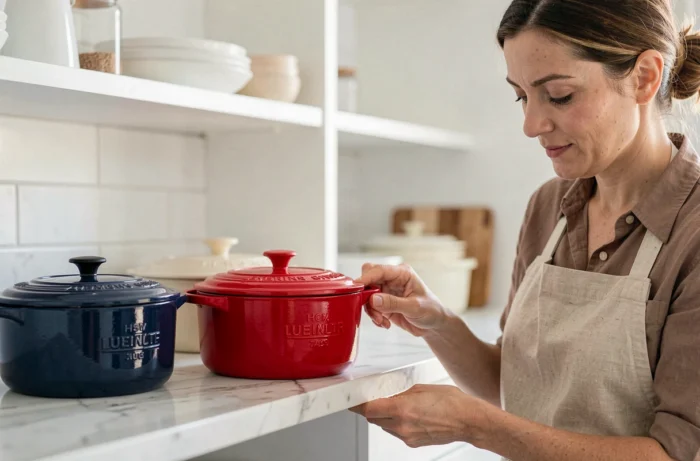
Le Creuset and Staub both advertise a lifetime warranty on their enameled cast-iron Dutch ovens. It sounds reassuring, but the fine print is worth reading. Staub’s product page specifies that it is a limited lifetime warranty, with terms that vary depending on the country of purchase.
In practice, these warranties generally cover manufacturing defects (cracks in the cast iron or premature chipping of the enamel) but exclude normal wear and tear, thermal shock or improper use. Heating an empty Dutch oven over high heat, for example, may void the warranty.
Brands that do not offer a lifetime warranty typically provide coverage for a few years. The question to ask is not “Is this Dutch oven covered for life?” but “Which types of damage are actually covered?” Savvy buyers check the terms that apply in their country before treating the warranty as a deciding factor.
Enameled cast iron, bare cast iron or cast aluminum: which finish suits your cooking needs?
The interior finish affects both everyday care and how versatile the Dutch oven is.
- Enameled cast iron (Le Creuset, Staub, Invicta) does not need seasoning. Staub says its enameled Dutch ovens can be washed with soap and water. The enamel protects the cast iron from rust and lets you cook acidic foods (tomatoes, wine) without affecting their flavor.
- Bare cast iron (unenamelled) needs regular seasoning: a thin layer of heated oil that creates a naturally nonstick surface. It suits cooks who are happy to maintain it in exchange for a cooking surface that improves with age.
- Cast aluminum with a nonstick coating (PTFE or ceramic) is lightweight and easy to clean. Que Choisir reports that some cast-aluminum models have been downgraded because metal migration exceeded regulatory limits, a safety factor to check before buying.
As for PFAS, current French law does not ban nonstick cookware. Check the coating used on the specific product rather than assuming that a model is prohibited or dangerous based on general regulations.
Le Creuset, Staub, Invicta: comparing Dutch oven brands using verifiable criteria
Rather than ranking brands, three factors provide a reliable basis for comparing manufacturers.
Where the specific model is actually made
Claims that a product is made in France can be checked for the specific model, not just the brand. Staub lists the place of manufacture on each Dutch oven’s product page. Le Creuset says its cast-iron Dutch ovens are made in France. Checking the product page for the exact model helps avoid sweeping generalizations.
Shape and size to suit the number of diners
A round Dutch oven works well for stews, soups and braised dishes. An oval Dutch oven is better suited to long cuts of meat (roasts, whole poultry). Le Creuset also offers a heart-shaped design, which is more decorative than practical.
Capacity is the factor most often misjudged. A Dutch oven that’s too large for two people wastes energy and can dry out food. Choose a size based on the number of people you actually cook for, rather than automatically opting for the largest one.
Price and positioning
Le Creuset cast-iron Dutch ovens start at around 175 euros for a small size and go up to about 389 euros for a large model with a water-reservoir lid. Cast-aluminum models from other brands cost between 20 and 120 euros for a 4-liter capacity, according to Que Choisir. The price difference reflects the material, thickness and expected lifespan.
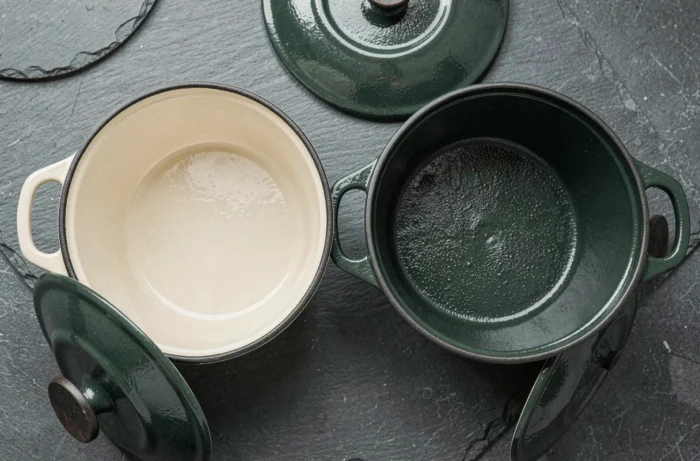
The lid also deserves attention. Le Creuset’s Doufeu system, with a water reservoir on the lid, encourages condensation cooking. Staub uses spikes on the underside of the lid to redistribute steam over the food. These technical details affect the final texture of slow-cooked dishes, and each brand has developed its own system.
Choosing a cast-iron Dutch oven comes down to practical factors: wall thickness, the exact type of finish, the full warranty terms, and a size suited to your everyday cooking. Comparing product specifications model by model is more reliable than relying on a brand’s reputation alone.