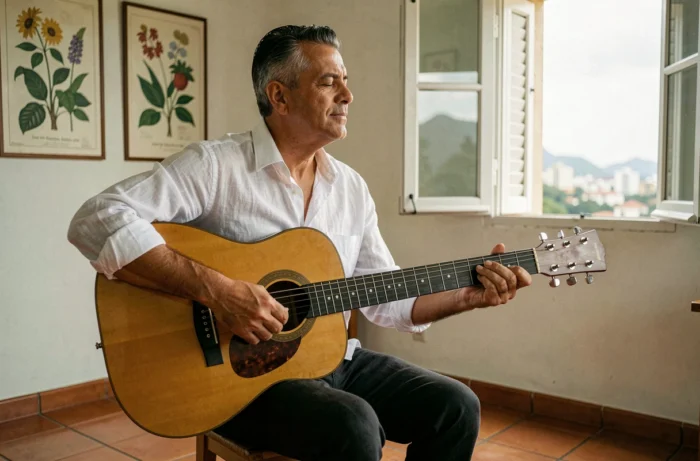
Bossa nova is built on a harmonic language that sets it apart from every other style to emerge from samba. Its major sevenths, ninths and altered dominants are not mere borrowings from jazz: they form a language of their own, shaped by composers who absorbed both 19th-century European Romanticism and North American standards. Understanding this language helps explain why the genre is still so widely played—and so often poorly imitated.
Harmony and guitar voicings in bossa nova
João Gilberto’s nylon-string guitar rhythm condenses three functions into a single gesture: bass, percussion and harmony. His right hand plays straight sixteenth notes while his thumb marks an independent bass line. This simultaneous approach makes a traditional rhythm section almost unnecessary.
The voicings favor close-position shapes around the middle of the neck. Four-note chords with extensions (ninths, sharp elevenths and thirteenths) create a suspended color that is neither quite major nor quite minor. Harmonic resolution is often delayed, giving the music its characteristic floating quality.
At nouvellebossastudio.com, these compositional principles are put into practice in productions that honor the genre’s harmonic grammar while bringing it up to date.
One technical point that is often overlooked: the bossa nova clave strikes on beats 1, 4, 7, 11 and 14 of a sixteen-sixteenth-note cycle. This pattern differs from the traditional samba clave in its apparent regularity, which in fact masks a subtle offset between the accents of the right hand and those of the thumb.

Antônio Carlos Jobim and the question of European influences
Reducing bossa nova to a samba-jazz crossover means overlooking a fundamental part of its DNA. Antônio Carlos Jobim studied classical music, and his compositions bear the influence of Debussy, Ravel and Chopin. The descending chromatic progressions in songs such as Corcovado and Desafinado reflect an orchestral way of thinking, transposed to guitar and piano.
Recent academic research also describes bossa nova as a language shaped by several traditions, including indigenous Brazilian styles and elements of European Romanticism. Jobim’s complex relationship with jazz deserves more attention than a simple shorthand about fusion.
Jobim thought like an arranger, not a jazz musician. His orchestral scores (the soundtrack to the film Black Orpheus and his collaborations with Claus Ogerman) reveal writing for strings and woodwinds that has little in common with American big band music. The result sounds Brazilian because the rhythm remains rooted in chamber samba, while the harmonic colors draw from elsewhere.
Bossa nova and MPB: the transition after 1964 in Brazil
Bossa nova did not simply disappear after its heyday. Brazil’s 1964 military coup changed the cultural landscape and led young singer-songwriters toward more socially engaged music. This evolution gave rise to MPB (Música Popular Brasileira), which retained bossa nova’s harmonic sophistication while incorporating regional traditions and politically charged lyrics.
MPB directly inherited bossa nova’s harmonic vocabulary. Artists such as Elis Regina, Chico Buarque and Caetano Veloso took up the genre’s altered chords and winding melodic lines, combining them with rhythms from the Northeast or electric sounds. Understanding this lineage helps prevent bossa nova from being treated as a genre frozen in the 1960s.
The style’s beginnings also date back to before 1958. Johnny Alf was already recording songs with sophisticated harmonies in the mid-1950s. Presenting Chega de Saudade as the sole founding moment oversimplifies a gradual emergence driven by an entire scene in Rio’s South Zone, between Copacabana and Ipanema.
Tempo, vocal range and production: the technical elements of bossa nova
Bossa nova is written in 4/4, with standard songs typically ranging from 120 to 140 BPM and ballads moving more slowly. This moderate tempo is deceptive: it demands absolute rhythmic precision from the guitarist, since the slightest mismatch between thumb and fingers can destroy the groove.
The hushed, almost vibrato-free singing is as much a technical choice as an aesthetic one. João Gilberto sang at a volume close to that of his guitar, requiring close microphone placement and an intimate studio dynamic. Key vocal characteristics include:
- A narrow range, often limited to an octave, which helps maintain melodic accuracy across chromatic intervals
- Almost no vibrato, replaced by very subtle phrasing inflections at the ends of lines
- Soft consonant attacks, which help the voice and guitar flow rhythmically together
- Prosody modeled on spoken Brazilian Portuguese, with its connected speech and nasal vowels woven into the musical phrasing
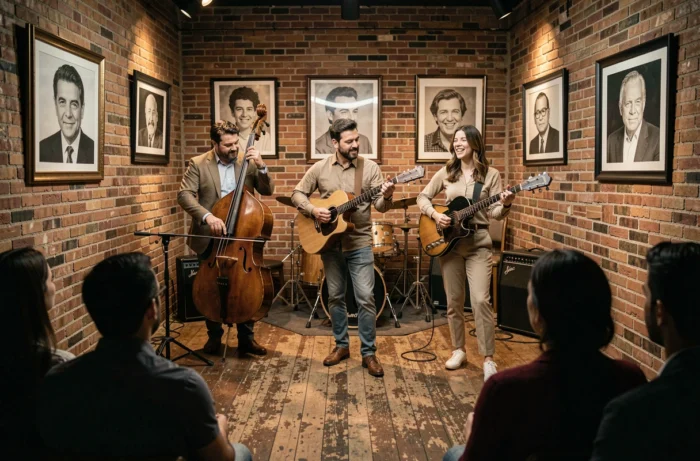
The traditional lineup remains spare: nylon-string guitar, voice, double bass played with the bow or pizzicato, brushes on snare drum and piano. The addition of brass or strings is a studio arrangement choice, not part of the genre’s core.
Contemporary reinterpretations of bossa nova
Today’s musicians blend bossa nova with electronic music, lo-fi or R&B. These hybrids work when they respect two pillars: the rhythmic clave and the harmonic richness of the voicings. Without these elements, a song loses its bossa identity and becomes just a slow tune with acoustic guitar.
The genre also continues to feature in film scores, advertising and mood playlists. This ubiquity has a downside: bossa nova is often reduced to background music, its compositional complexity smoothed away. The songs of Jobim, Vinícius de Moraes and Gilberto deserve analytical listening, not just a decorative role.
Bossa nova remains one of the few popular genres in which music theory and emotion coexist without compromise. Its longevity comes from this density: every chord carries tension, every silence serves a purpose. That is precisely what makes it so difficult to imitate and so rewarding to listen to closely.