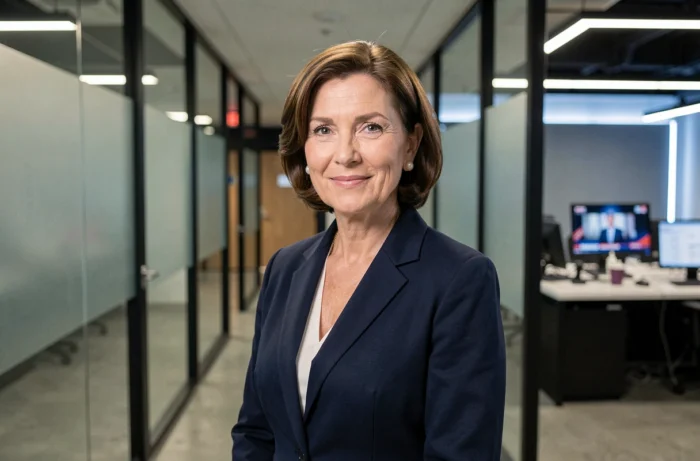
Maryse Burgot, a senior reporter for France Télévisions, has shared her life with a man about whom very little is ultimately known. Their marriage, their years together, and their separation have only surfaced publicly through a few measured statements from the journalist herself, notably in the podcast Quincanailles. The subject touches on the boundary between media life and protected intimacy, and verifiable information remains scarce.
What Maryse Burgot has revealed about her marriage and separation
The interview granted by Maryse Burgot to Marie-Pierre Benitah in the podcast Quincanailles remains the most significant direct source. She explains that she was “very very happy” in her relationship and that the life she leads today “was not her choice.”
In a few words, the framework is set. The separation was initiated by her ex-husband, not by her. Burgot has never sought to turn this confidence into a media narrative, and these phrases are among the few she has publicly spoken on the subject.
The name of Jonathan Halls, ex-husband of Maryse Burgot, frequently appears in search results related to this story. This name circulates widely online, but no major journalistic source independently confirms it. Burgot’s revelations identify the father of her two sons as her former husband, without the complete identity of this individual being verifiable elsewhere.
This distinction is important. Many gossip contents rephrase and extrapolate from snippets. Separating Burgot’s direct statements from editorial interpretations allows for respecting the perimeter she herself has drawn.

War reporter and couple life: the constraints of the field
Years of covering conflict zones for France Télévisions, long absences, constant physical risks. When looking at Maryse Burgot’s career, the tensions that her profession may have created in her relationship become concrete.
She has mentioned in several interviews a rule she imposes on herself: never to cut the link with her sons during her reports, even from the most dangerous locations. This discipline reflects the ongoing tension between professional commitment and parental presence.
Time zone differences, inability to plan, returns marked by what the journalist has experienced on-site. These daily realities weigh on any relationship. Burgot has never minimized them.
A book as a primary source
Her book Loin de chez moi, published by Fayard in October 2024, traces her journey as a senior reporter and her Breton origins. It is the most reliable source for understanding her trajectory, far from the compilations of gossip articles circulating online.
It provides the context that is lacking elsewhere. The separation is part of a journey where the career has been built in the field, with the personal sacrifices that come with it. Burgot talks about her profession without seeking sympathy, which makes her testimony all the more solid.
Maryse Burgot’s divorce: untangling the verifiable from the speculative
A search on this separation leads to very uneven content. Some sites offer precise details about the ex-husband’s identity or the circumstances of the breakup, without ever citing a single direct source.
What can be considered established from the journalist’s statements:
- Maryse Burgot is divorced and did not choose this separation, as she stated in the podcast Quincanailles
- She has two sons, Angelo and Noé, with whom she maintains a constant connection even during her professional travels
- She publicly embraces her situation as an independent woman, without seeking to rebuild a couple’s image
- Her book Loin de chez moi, published by Fayard, offers a first-hand account of her journey, without focusing on her romantic life
What is not established: the precise identity of the ex-husband (the name Jonathan Halls circulates widely without any recognized journalistic source confirming it), the exact reasons for the separation beyond what Burgot has disclosed, and any information regarding the current life of her former spouse.
A discretion that complicates research
Maryse Burgot protects her private life with the same rigor she applies to her reports. No repeated interviews on the subject, no corrections of erroneous information, no attempts to control the media narrative around her personal life.
This silence creates a void that other content fills, sometimes with unfounded assertions. For those wanting to understand this story, sticking to the journalist’s direct statements remains the only solid approach.

Beyond the Burgot case: the private lives of field reporters
Repeated absences, exposure to danger, emotional dislocation upon return. What Maryse Burgot has gone through, many senior reporters know. Couples strained by this rhythm are common in the profession.
What distinguishes her is the choice not to instrumentalize this ordeal. Where other media figures turn their private lives into content, she sticks to a few measured phrases and lets her work speak.
Her two sons remain at the center of her priorities. Angelo and Noé are growing up with a mother whose job involves regular departures, but who has established strict rules to maintain family ties.
Maryse Burgot’s separation is neither a scandal nor a soap opera. It is a breakup she did not ask for, which she mentioned once with sobriety, and which does not define her public identity. Her work as a reporter, however, continues.