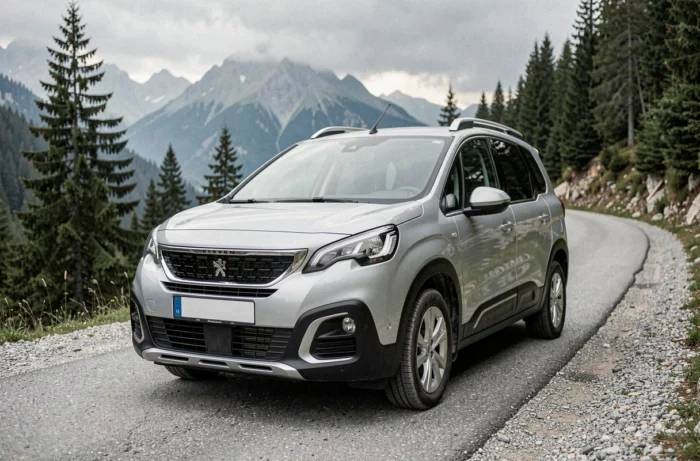
Three children in car seats, two adults, a stroller, a sleeping bag for each person, and the shopping bag from the last stop: this is the kind of scenario that puts any family vehicle to the test. The Peugeot Rifter 7-seater, in its Long version, promises to fit everyone without turning the journey into a game of Tetris. The boot’s actual capacity with all seats in place deserves an honest look before you sign on the dotted line.
Rifter Long 7-seater boot space: how much room is really left for luggage?
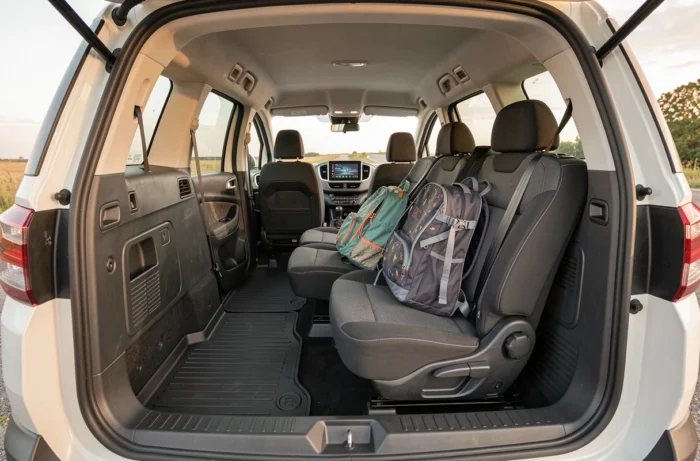
Let’s get straight to the main issue. With all seven seats in place, the Rifter Long offers 209 to 322 litres of boot space, depending on the position of the third row. Sliding the bench as close as possible to the second-row seats frees up the most space. Moving it back to give rear passengers more legroom eats into the boot.
For perspective, 209 litres is barely enough for two cabin suitcases laid flat. A week-long holiday for five people (two adults and three children) requires far more luggage space. Without a roof box or trailer, a proper holiday trip with seven people is a tight squeeze.
The question isn’t whether the Rifter is spacious (it is, compared with a compact MPV), but how many passengers you’ll actually carry day to day. When you use the Peugeot Rifter 7-seater as a family car with five occupants and the third row folded down, the boot becomes generous again. The seventh seat works as a wildcard, not as a permanent travel configuration.
130 hp diesel or electric e-Rifter: which powertrain suits your family’s journeys?
Peugeot’s current Rifter range offers at least two distinct options. A 130 hp diesel is still available, while the 136 hp electric e-Rifter comes with a 54 kWh battery.
e-Rifter claimed range and real-world limitations
The manufacturer claims a range of up to 339 km on the standard test cycle. On the motorway, with seven people on board and the air conditioning or heating on, that figure drops. Headwinds, cold weather and sustained high speeds significantly reduce range compared with the WLTP cycle.
For families whose journeys mainly involve the school run, shopping and weekend outings within 150 km, the e-Rifter covers almost all their needs without requiring them to plan charging stops. For motorway holiday trips with mandatory charging stops, the diesel has a clear practical advantage.
Diesel: the choice for long journeys with a full load
The 130 hp diesel engine remains the logical choice for families who regularly cover several hundred kilometres. No need to plan charging stops, no time lost recharging, and plenty of torque at low revs to tow a luggage trailer if the boot isn’t big enough.
The choice between the two powertrains depends less on environmental convictions than on how you actually use the car. Keeping a log of your journeys for a month will give you a more reliable answer than anything in a brochure.
Child seats and versatility: configuring the Rifter for three children
Fitting three child seats (or two child seats and a booster) across the Rifter’s second row is possible, but it’s worth checking the width of the centre seat against the child seat you plan to use. Isofix points are provided on the outer seats in the second row. The centre seat can accommodate a child seat secured with a three-point seat belt.
- Second row: two outer Isofix points and a centre seat with a seat belt. There’s enough width for most infant carriers and booster seats on the market, as long as you don’t choose three extra-wide models.
- Third row: two individual fold-away seats, suitable for children or teenagers. Access is via the folding second-row seats, which means removing a child seat each time.
- Flat floor and mounting rails: the third row folds into the floor, creating a load space with no step. This versatility sets the Rifter apart from 7-seat SUVs, where the third row folds up against itself rather than disappearing.
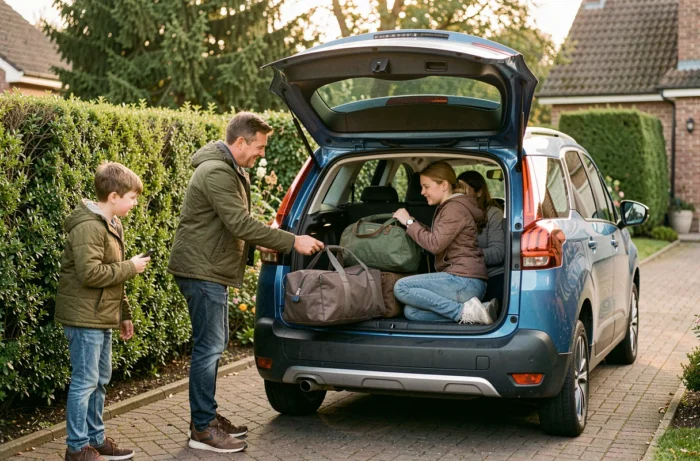
In practice, the easiest everyday setup is five occupants (three children in the second row and two adults up front) with the third row folded away. You can deploy the third row for occasional trips with grandparents or friends.
Rifter 7-seater versus the alternatives: SUV, MPV or leisure activity vehicle
The Rifter is neither a raised SUV nor a low-floor MPV. It’s a leisure activity vehicle—in other words, a van adapted for family life. This commercial-vehicle platform gives it one clear advantage and one drawback.
The advantage: generous headroom, making it easier to get children into their seats without straining your back. The sliding side doors protect the car parked next to you at the school car park. No 7-seat SUV in this segment offers the same combination.
The drawback: on the road, it still feels like a vehicle derived from a van. The suspension prioritises comfort and load-carrying over agility. On winding roads, you feel the weight and body roll more than in an MPV designed from the outset for road use.
For families weighing it up against a Citroën Berlingo XL (its technical cousin) or a Renault Kangoo, the differences come down to the cabin atmosphere, Peugeot’s i-Cockpit and the trim. The boot dimensions and wheelbase are almost identical in the Rifter Long and Berlingo XL.
The Rifter 7-seater delivers on its promise if you accept what it’s designed for: a vehicle built for space and versatility, not image or sporty handling. With all seven seats occupied, luggage spills over. With five occupants and the third row folded away, it becomes one of the most practical vehicles in its class for everyday family life.